Imagine that you are a prisoner in the United States in the 1800s. Even though your offense was minor, such as owing a $10 debt, you are thrown into prison with more serious criminals such as murderers. The conditions are horrible, including cages, torture, disease and death. Maybe you are a woman but you are still imprisoned with men and children. Since you are in prison, you cannot work to pay your small debt off, so your prison sentence becomes longer and longer. Perhaps you are mentally ill and do not even understand what you did was wrong but suffer the harsh consequences anyway. When and if you finally get out you have no education or job waiting for you and do not know how to fit back into society.This was the realty for many imprisoned people in the 1800s.

Conditions of Prisons in the Early 1800s
Prisons were brutal in the early 1800s. They were overflowing, murderers and other hard criminals were housed with light offenders and men, women and children and the mentally ill were all housed together. Prisoners were confined to cages, closets, cellars, stalls and pens. They were chained, beaten with rods and whipped into obedience. There was no source of income or education for prisoners. In 1821 in Auburn Prison, NY a horrible event happened that sparked reform. After consultation with the Pennsylvania exponents of the system of solitary confinement, the New York reformers succeeded in securing the act of April 2, 1821, directing the prison inspectors to select a number of the "oldest and most heinous offenders" and put them in solitary confinement, with the end in view of observing its disciplinary effects. A second class was to be put in separate cells for three diys each week, while the younger offenders were to be allowed to work in the shops six days each week (Barnes). 80 men were locked in solitary confinement and many of them committed suicide or had mental breakdowns because of the horrible conditions and mental anguish of solitary confinement (Prison and Asylum). This event could be considered the catalyst and beginning of prison reform.
Specific Goals of Prison Reform
The goals of prison reform were betterment of prison conditions with prison's purpose reconceived as rehabilitation rather than punishment. Reformers wanted more humane treatment for prisoners. They wanted to add salvation, religion and Sabbath School. Reformers hoped for prison libraries, basic literacy, reduction of whipping and beating, commutation of sentences and separation women, children and the sick.
Leaders in Prison Reform
Louis Dwight was a leader in prison reform. He was the founder of the Boston Discipline Society which was an organization that checked on prisons to make sure they were running properly.
Dorothea Dix was another great leader in prison reform. She was a teacher who taught Sunday school in a jail and was horrified by the conditions.
The prison reformists often had Anabaptist roots, especially Baptist and Quakers. They were from forms of faith that were moralizing. They didn't believe in "endless misery" (Buescher). They were more humanitarian and optimistic and believed in a more joyful Heaven on Earth (Buescher).
How Reformists Accomplished Their Goals
Louis Dwight took the prisons from the overcrowded Auburn Prison and spread them out to other prisons in the United States after the incident there. He added religion and Sabbath School to prisons. He set up a system where the prisons would be checked on regularly to make sure they were running properly called the Boston Prison Discipline Society.
Dorothea Dix was horrified by the conditions of the prison where she taught. For two years she gathered information about what she had seen. She then prepared a report to present to the Massachusetts legislature. She is quoted as saying in her report "I come as the advocate of helpless, forgotten, insane and idiotic men and women. I proceed, gentlemen, briefly to call your attention to the present state of insane persons, confined....in cages, closets, cellars, stalls and pens! Chained, naked, beaten with rods, and lashed into obedience!" (Dix) The legislature was shocked by her report and voted to create asylums for the mentally ill. She did this for other prisons in the United States too, visiting hundreds and working to get them proper food, clothing, heat and education.
Outcome and Success of the Reform Movement
The reform movement had success. The work of Dorothea Dix created public asylums for the mentally ill, separated men, women, children and the sick, special justice systems for children, outlawed cruel and unusual punishments. Under the Eighth Amendment to the U.S. Constitution, individuals convicted of a crime have the right to be free of "cruel and unusual" punishment while in jail or prison (Find Law).The state governments no longer put debtors in prison and prisoners were separated based on the severity of their crimes. Learning to read and education were available to prisoners. The work of Louis Dwight created the Boston Discipline Society with inspectors to inspect the prisons. He also added religion into prisoners. The attitude was more toward rehabilitating prisoners. The reform movement was so successful that Europe looked to the United States as a model for building, utilizing and improving their own prisons (Reform Movements).
Present Day Reform
Prison reform of the 1800s has carried over in many ways to present day reform. Cruel and unusual punishment is outlawed. Systems are in place to check on prisons to make sure they are up to code and doing things properly. Education is a bit more available to prisoners. Incarceration is done based on the severity of the crimes from maximum security to daytime work release. There is a classification of prisoners based on their crimes. There is a separation of men, women, children and the mentally ill. Prisoners must have adequate food, heat, clothing and other necessities (Woodruff).
Current Problems
Even though there has been a lot of reform, there are still many problems in the prison system. Some of these problems include over-crowding, health conditions of prisoners are poor, cost of imprisonment is too high, education is not always available and too many children are put in the system.
Modern Day Reform
Many organizations in the present work to better prison conditions and continue the work from the 1800s. One of these organizations is Books Through Bars which provides books and educational materials to prisoners. Books Through Bars is based in Philadelphia, PA. They are a volunteer run organization that distributes free books and educational materials to incarcerated people in Pennsylvania, New Jersey, New York, Maryland, Delaware, Virginia and West Virginia. Each week they receive hundreds of letters from prisoners requesting books. They send out about 8,000 book packages per year. They rely on donations of books, time and money to pay for postage, power, machines and materials.Their mission is to educated people who have been pulled out of schools and society and put in prison so when they are released they have a better chance of fitting back into society and being productive. They do this in hopes that people will have a better life when they get out of prison (Books Through Bars).
How Prison Reform Shapes Our Identity As Americans
There are many ways that prison reform has shaped our identities as Americans. Other countries looked to our prisons after the 1800s reform movement as a model for their own. This made America a pioneer for prison reform. Prisons were seen more as a place for rehabilitation rather than punishment which shows a more humane side of Americans. Separating the sick from regular prisoners shows that Americans have a better understanding of mental illness. Books and schooling in prison shows that education is important to Americans.
Works Cited
Auburn Prisoners In Lockstep. 1819. Cayuga County NY Government, www.cayugacounty.us/. Accessed 6 June 2018.
Barnes, Harry Elmer. "Historical Origin Of The Prison System In America." Journal of Criminal Law and Criminology, 1921, scholarlycommons.law.northwestern.edu/jclc/vol12/iss1/5/. Accessed 6 June 2018.
Books Through Bars. booksthroughbars.org/. Accessed 29 May 2018.
Broadbent, Samuel. Dorothea Lynde Dix. 1850. The Boston Antathaeum. Accessed 6 June 2018.
Buescher, John. "The Era Of Reform." teachinghistory.org, 2018, teachinghistory.org/history-content/ask-a-historian/24100. Accessed 22 May 2018.
Escobedo, Tricia. "What's Going on with Prison Reform In America?" CNN, 21 Oct. 2015, www.cnn.com/2015/10/21/us/prison-reform-overview/index.html. Accessed 29 May 2018.
Gale, Thomas. "The Prison Reform Movement." Encyclopedia.com, 2007, www.encyclopedia.com/social-sciences/news-wires-white-papers-and-books/prison-reform-movement. Accessed 24 May 2018.
GPO.gov. 2014, www.gpo.gov/fdsys/pkg/CHRG-113hhrg88721/pdf/CHRG-113hhrg88721.pdf. Accessed 23 May 2018.
Issue Lab. www.issuelab.org/issues/prison-and-judicial-reform. Accessed 23 May 2018.
"Prison And Asylum Reform." Reform Movements, Weebly, reformmovements1800s.weebly.com/prison-and-asylum-reform.html. Accessed 23 May 2018.
"Prison and Asylum Reform." USHistory.org, 2018, www.ushistory.org/us/26d.asp. Accessed 22 May 2018.
United Nations Office on Drugs and Crimes. www.unodc.org/unodc/en/justice-and-prison-reform/index.html. Accessed 23 May 2018.
"US Constitution." Find Law, 2018, criminal.findlaw.com/criminal-rights/cruel-and-unusual-punishment.html. Accessed 6 June 2018.
Wondolowski. "Prison Reforms in the 1800s." TimeToast, timetoast.com/timelines/prison-reforms-in-the-1800s.
Woodruff, Lynne. "Prison Reform: The Origin of Contemporary Jail Standards." Lexipol, 22 Feb. 2017, www.lexipol.com/news/prison-reform-origin-contemporary-jail-standa

Dorothea Dix photographed by Samuel Broadbent circa 1850
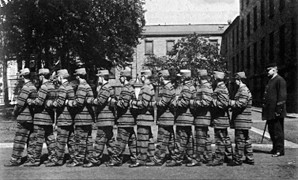
Auburn Prisoners circa 1819 - photo property of Cayuga County NY Goverment

Books Through Bars provides free books and educational materials to prisoners.
www.booksthroughbars.org